Evaluating Therapist Log Book KDP Interiors for Professional Publishing
Creating a functional and compliant log book for mental health professionals requires balancing aesthetic appeal with strict utility. When sourcing or creating interiors for Amazon KDP, the distinction between a generic notebook and a specialized clinical tool is significant. Therapist Log Book KDP Interiors are designed specifically to address this niche, providing structured layouts that cater to session tracking, client progress monitoring, and administrative organization. Unlike standard journals, these interiors must adhere to specific formatting standards while offering enough flexibility to be useful across different therapeutic modalities.
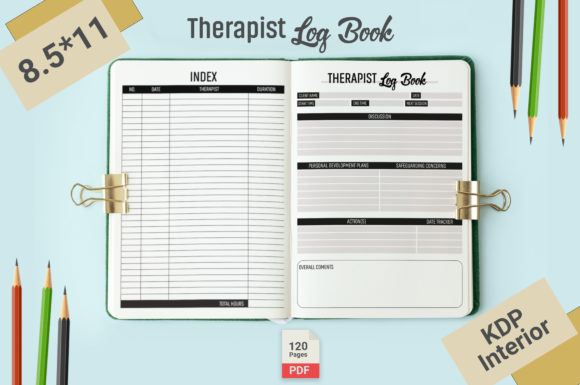
For publishers and designers targeting the mental health market, understanding the technical and practical specifications of these files is essential. A high-quality resource in this category typically includes 100 editable source files in Adobe Illustrator (AI) format alongside a 120-page print-ready PDF. The standard trim size of 8.5×11 inches provides ample space for detailed notes, while the no-bleed configuration simplifies the printing process and reduces potential formatting errors during upload. Evaluating whether this specific type of interior asset meets your publishing goals involves comparing it against custom design services, generic templates, and other low-content book strategies.
Technical Specifications and File Utility
The primary value proposition of pre-made Therapist Log Book KDP Interiors lies in the inclusion of editable vector source files. While many KDP resources only provide flattened PDFs, access to AI files allows for significant customization. This capability is crucial for therapists who may want to rebrand the interior with their practice logo, adjust prompt wording to match specific cognitive behavioral therapy (CBT) or dialectical behavior therapy (DBT) frameworks, or modify margins to accommodate spiral binding if they choose to use third-party printers later.
The 8.5×11 inch trim size is the industry standard for clinical documentation. Smaller sizes, such as 6×9, are often preferred for personal journals but can feel restrictive for professional log books where practitioners need to record detailed session notes, intervention strategies, and homework assignments. The 120-page count offers a substantial volume that feels like a complete product without pushing printing costs into a higher bracket. Furthermore, the no-bleed specification is a deliberate choice for this category. Text-heavy interiors with structured tables and lines rarely benefit from bleed; keeping all elements within the safe margin ensures that critical writing spaces are never truncated during the trimming process, which is a common issue with poorly formatted bleed interiors.
Resolution and Print Quality Considerations
High-resolution interiors are non-negotiable for professional publications. Blurry lines or pixelated text immediately undermine the perceived value of a clinical tool. When evaluating Therapist Log Book KDP Interiors, verify that the PDF export settings maintain vector sharpness at 100% zoom. Rasterized templates often degrade when scaled or printed, whereas true vector-based AI files ensure crisp lines regardless of the printer used. This technical fidelity distinguishes professional-grade assets from amateur designs found on free template sites.
Comparing Pre-Made Assets to Custom Design
Publishers often weigh the decision between purchasing ready-to-use interiors and hiring a freelance designer. Each approach has distinct tradeoffs regarding cost, time, and uniqueness.
- Cost Efficiency: Hiring a professional book formatter or illustrator to create a 120-page custom interior can range significantly in price. In contrast, downloadable Therapist Log Book KDP Interiors offer a fraction of that cost, making them accessible for new publishers testing the niche.
- Time to Market: Custom design requires briefing, revision cycles, and final proofing, often taking weeks. Downloadable assets allow for immediate deployment. If you have an existing audience or a timely marketing window, the speed advantage is substantial.
- Exclusivity vs. Functionality: Custom designs guarantee uniqueness. However, in the therapist log book niche, functionality often trumps novelty. Practitioners generally prefer familiar, standardized layouts over experimental designs. Pre-made interiors based on established clinical formats can sometimes outperform unique but untested custom layouts because they align with user expectations.
While custom design is superior for building a distinctive brand identity, pre-made interiors serve as an excellent baseline. The inclusion of editable AI files bridges the gap, allowing publishers to modify headers, fonts, and structural elements to create a semi-custom product without the full expense of ground-up design.
Functional Fit: When Standard Interiors Work Best
Not all therapist log books require bespoke solutions. Therapist Log Book KDP Interiors are particularly well-suited for specific use cases where standardization is an asset rather than a liability.
General Practice and Private Practice Startups
New private practitioners often need immediate organizational tools without the budget for custom stationery. Generalist log books that include sections for client demographics, session dates, presenting problems, interventions, and follow-up plans meet the needs of a broad audience. These users prioritize structure and compliance over branding. A well-organized, 8.5×11 interior with clear prompts supports their workflow effectively.
Supervision and Training Logs
Clinical supervisors and interns require specific tracking formats for licensure hours and competency evaluations. Pre-made interiors that focus on hour tracking, supervision notes, and skill acquisition are highly functional in this context. Because regulatory bodies often mandate specific data points, standardized forms are actually preferred over creative interpretations. Ensuring the interior covers these mandatory fields makes it a viable resource for academic and training markets.
Niche Specialization Limitations
Conversely, highly specialized niches may find general Therapist Log Book KDP Interiors insufficient. For example, play therapists, art therapists, or somatic experiencing practitioners often require non-linear note-taking spaces, drawing areas, or body maps that standard text-based logs do not provide. Similarly, EMDR practitioners need specific bilateral stimulation tracking sheets. In these instances, a generic interior serves only as a starting point. Publishers targeting these sub-niches should utilize the editable AI files to fundamentally restructure pages or seek specialized templates designed explicitly for those modalities.
Evaluating Alternatives and Market Positioning
Understanding the competitive landscape helps in positioning a log book effectively. Therapist Log Book KDP Interiors exist within a broader ecosystem of documentation tools.
Digital Documentation Platforms: Many therapists use Electronic Health Records (EHR) systems. Physical log books compete by offering a tangible, offline backup or a reflective journaling space that screens cannot provide. Marketing should emphasize the cognitive benefits of handwriting and the security of paper records that are not subject to data breaches or subscription fees.
Generic Planners and Journals: Standard planners lack clinical prompts, forcing therapists to draw their own tables or write unstructured notes. Dedicated log books save time and ensure consistency. However, some practitioners prefer the freedom of dot-grid notebooks. To compete, Therapist Log Book KDP Interiors must demonstrate that their structure adds value rather than restriction. Including flexible sections or blank reflection pages alongside structured logs can appeal to hybrid users.
Print-on-Demand Competitors: The KDP marketplace contains many low-effort log books. Differentiation comes from interior quality and usability. Books with proper margins, readable fonts, and logical flow stand out against those created with automated software. Using high-resolution, professionally designed interiors signals quality to potential buyers browsing "Look Inside" previews.
Decision Factors for Publishers and Creators
Selecting the right interior asset requires honest assessment of your capabilities and goals. Consider the following factors when deciding if this specific Therapist Log Book KDP Interior package is appropriate.
- Software Proficiency: Do you have access to and knowledge of Adobe Illustrator? If not, the editable AI files lose much of their value, and you are limited to the static PDF. Ensure you can utilize the full asset package before investing.
- Target Audience Specificity: Are you targeting general counselors or specialized clinicians? Review the sample pages to confirm the prompts align with your audience's daily workflow. Mismatched terminology can lead to negative reviews.
- Licensing Terms: Verify the commercial use license. Some assets allow unlimited publications, while others limit the number of titles or require attribution. Understanding these terms prevents future legal complications.
- Modification Capacity: Even with editable files, significant redesign takes time. Assess whether the base template is close enough to your vision that modifications are minor tweaks rather than major overhauls.
Best Practices for Implementation
To maximize the effectiveness of Therapist Log Book KDP Interiors, treat the download as a foundation rather than a finished product. Always order a physical proof copy before launching. Screen resolution does not accurately represent line weight, paper opacity, or binding margins. What looks perfect digitally may be too faint to write on or too close to the gutter in print.
Consider adding value through supplementary content. Introductory pages explaining how to use the log book, HIPAA compliance reminders, or crisis resource lists can transform a simple interior into a comprehensive professional resource. These additions differentiate your publication from others using the same base files.
Finally, maintain awareness of evolving clinical standards. Documentation requirements change, and therapeutic approaches evolve. Regularly updating your interiors based on user feedback and industry shifts ensures long-term relevance. Therapist Log Book KDP Interiors provide an efficient entry point into professional publishing, but sustained success depends on thoughtful adaptation and commitment to serving the practical needs of mental health practitioners.