Evaluating 65 Unique Pages KDP Interiors for Low-Content Publishing
Selecting the right interior template is often the most critical variable in the success of a low-content or medium-content book on Amazon KDP. While cover design attracts the initial click, the interior determines customer satisfaction, review ratings, and long-term sales velocity. The 65 Unique Pages KDP Interiors collection by De-Team represents a specific tier of digital asset designed to balance variety with technical compliance. For publishers aged 20 to 50 who are scaling their catalogs or seeking to diversify beyond generic lined paper, understanding the practical utility and limitations of this specific package is essential for making an informed investment.
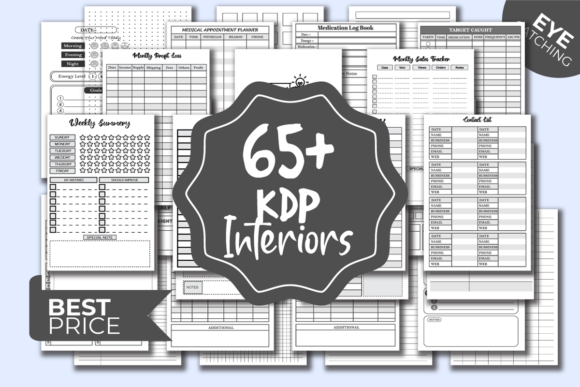
This resource is distinct because it moves away from the repetitive structures found in free or entry-level bundles. Instead of offering hundreds of slight variations of the same grid, it focuses on 65 structurally distinct layouts. This distinction matters significantly for publishers trying to avoid Amazon’s duplicate content filters and customers who are increasingly fatigued by identical interiors across multiple bestsellers. When evaluating this product against broader market alternatives, the focus shifts from sheer volume to functional diversity and editability.
Technical Specifications and Platform Compliance
Before assessing creative potential, one must verify technical alignment with current KDP printing standards. The 65 Unique Pages KDP Interiors package is engineered with specific constraints that mitigate common publishing errors.
- Dimensions: Standard 8.5″ x 11″ inches, the most versatile trim size for journals, planners, and activity books.
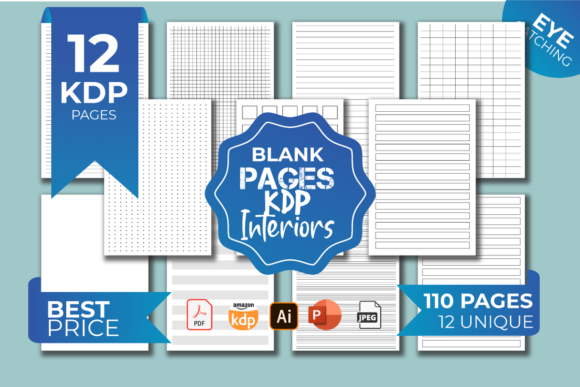
- Page Count: 110 pages per file, optimized to meet minimum page count requirements for spine text while keeping printing costs within standard royalty thresholds.
- Bleed Setting: No Bleed configuration, which simplifies the upload process and reduces rejection risks for beginners.
- File Formats: Includes PDF for direct upload, AI (Adobe Illustrator) for vector editing, and JPEG for preview or mockup creation.
The "No Bleed" specification is a deliberate tradeoff. While full-bleed interiors allow graphics to extend to the page edge, they require precise margin management and can lead to trimming inconsistencies if not set up perfectly. By utilizing a no-bleed setting, these interiors ensure a safe margin buffer. This makes the 65 Unique Pages KDP Interiors particularly suitable for text-heavy layouts, prompts, and structured lists where content clarity takes precedence over edge-to-edge artwork. However, publishers specifically aiming for immersive coloring books or full-page artistic spreads may find this limitation restrictive and might need to seek full-bleed alternatives.
Editability Versus Ready-to-Upload Convenience
A primary decision factor when comparing interior resources is the level of customization required versus desired. Many marketplace options fall into two extremes: static PDFs that cannot be altered, or complex source files requiring advanced design skills. De-Team positions this product in the middle ground by providing editable AI files alongside ready-to-use PDFs.
The inclusion of Adobe Illustrator source files transforms this from a simple template pack into a foundational design system. For publishers who understand vector editing, this allows for significant modification. You can adjust fonts to match your brand identity, alter prompt wording to target specific niches (e.g., changing "Daily Gratitude" to "Nurse Shift Reflections"), or combine elements from different pages to create hybrid layouts. This editability addresses a common pain point: purchasing a template only to realize the font style clashes with your cover design or the prompts are too generic for your target audience.
Conversely, if you lack vector editing software or prefer a strictly passive workflow, the value proposition changes. You would be limited to the pre-rendered PDFs. In this scenario, you must compare the existing 65 designs directly against your niche requirements. If the out-of-the-box content aligns with your vision, the PDF option saves time. If not, the inability to edit becomes a bottleneck. This contrasts with Canva-based alternatives, which offer easier drag-and-drop editing but often lack the professional vector precision and print-ready resolution of AI/PDF workflows.
Assessing Content Uniqueness and Market Saturation
The claim of "unique pages" requires critical evaluation in a saturated marketplace. In the context of 65 Unique Pages KDP Interiors, uniqueness refers to structural and functional variation rather than just aesthetic differences. When researching alternatives, many bundles advertise "500+ pages" but actually contain only five base templates with minor border changes. This inflation leads to market saturation where dozens of books share the same core user experience.
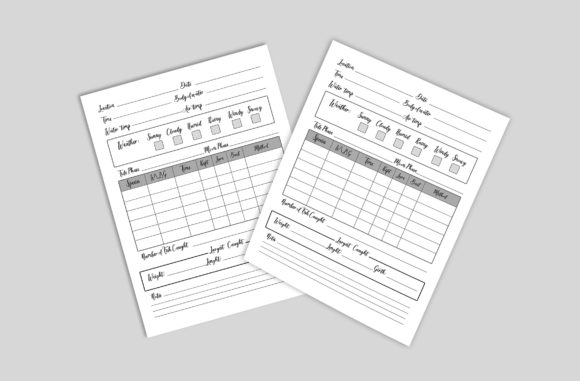
De-Team’s approach prioritizes functional distinctness. With 14 unique page types highlighted within the broader 65-page ecosystem, the collection supports the creation of multi-faceted books. For example, a single wellness journal could utilize habit trackers, mood grids, free-writing spaces, and goal-setting frameworks without repeating the same layout. This variety increases the perceived value of the final book for the consumer.
However, uniqueness is relative. As with any commercial template, there is a risk that other publishers are using the same assets. To mitigate this, experienced publishers use these interiors as a baseline rather than a final product. The strategic advantage lies in combining these professional layouts with proprietary content, custom introductions, or niche-specific modifications. If you intend to upload the PDFs exactly as provided without any differentiation, the long-term viability of the book may be lower compared to competitors who customize their assets.
Comparative Analysis: When to Choose This Resource
Determining whether 65 Unique Pages KDP Interiors is the correct fit depends on your current publishing stage and business model. It is helpful to categorize decision-making based on specific publisher profiles and needs.
Ideal Use Cases
This collection is strongly aligned with intermediate publishers and niche researchers who prioritize quality over quantity. It serves as an excellent solution for:
- Niche Validation: Testing new categories like shadow work, specialized fitness logging, or educational worksheets without investing in custom design from scratch.
- Series Development: Creating cohesive branded series where consistent margins and typography are crucial, facilitated by the uniform 8.5x11 no-bleed framework.
- Hybrid Books: Projects requiring a mix of structured data entry and open reflection, leveraging the diverse page types included in the bundle.
- Designers Seeking Base Assets: Professionals who want high-quality vector foundations to speed up custom client work or personal projects.
Situations Requiring Alternatives
Despite its strengths, this product is not a universal solution. Publishers should consider alternative resources if:
- Full-Bleed Artistry is Required: Coloring books or art journals needing edge-to-edge printing will require bleed-compatible templates.
- Non-Standard Trim Sizes are Needed: If your strategy relies on 6x9, 5x8, or square formats, this 8.5x11 specific package will require resizing that may distort proportions or ruin margins.
- Zero-Edit Workflow is Mandatory: If you cannot use Illustrator and the existing PDF prompts do not match your niche, a platform-native tool like Canva or Book Bolt’s interior creator may offer better immediate utility.
- High-Volume Generic Production: If the goal is mass-producing basic lined notebooks, simpler and cheaper bulk packs may offer better ROI, as the unique features here would be underutilized.
Evaluating Vendor Reliability and Design Philosophy
In the digital asset space, the vendor's reputation and design philosophy are as important as the file itself. De-Team distinguishes itself through a stated purpose of "quality full design consider the customer requirements." This suggests a user-centric approach rather than a purely algorithmic generation of pages. When comparing vendors, look for evidence of this consideration in the file organization, naming conventions, and technical accuracy.
Poorly organized asset packs waste hours of production time. A professionally curated package like 65 Unique Pages KDP Interiors typically includes clear labeling and consistent layer structures in AI files. This operational efficiency compounds over time; saving ten minutes per book setup adds significant capacity when managing a large catalog. Furthermore, vendors focused on quality tend to update their assets to reflect changing KDP guidelines, reducing the risk of future account warnings related to outdated specifications.
Making the Final Decision
Ultimately, the decision to acquire 65 Unique Pages KDP Interiors should be based on a gap analysis of your current inventory. Review your existing templates and identify where you lack structural variety or professional polish. If your current offerings are heavily skewed toward basic lines or grids, and you wish to expand into guided journals or activity books within the 8.5x11 no-bleed format, this collection fills a specific functional void.
Compare the cost against the time required to create 65 unique, compliant layouts from scratch. For most publishers, the time savings justify the expense, provided the editability features are utilized to maintain brand distinctiveness. Approach this resource not as a shortcut to instant sales, but as a professional-grade component in a broader publishing strategy. By leveraging the technical compliance and structural variety offered by De-Team, while applying your own niche expertise and customization, you can create products that stand on their own merit in a competitive marketplace.