Maximizing KDP Profits with Editable Assignment Planner Interiors
The low-content publishing market on Amazon KDP has evolved significantly. Gone are the days when simply uploading a generic lined notebook would generate consistent sales. Today, successful publishers focus on utility, niche specificity, and professional presentation. For those targeting the academic and student organization sector, the Assignment Planner - KDP Interiors Vol-3 represents a strategic asset. This isn't just a static PDF; it is a comprehensive toolkit designed for creators who understand that customization is the key to standing out in a saturated marketplace.
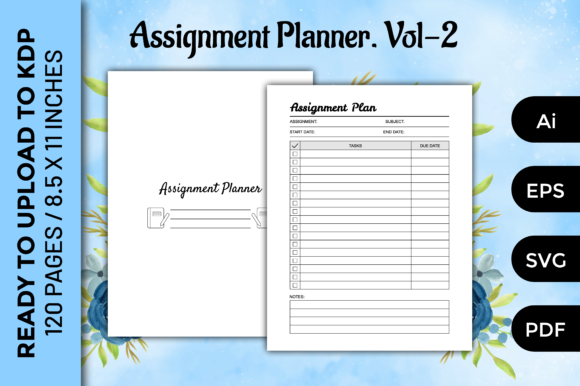
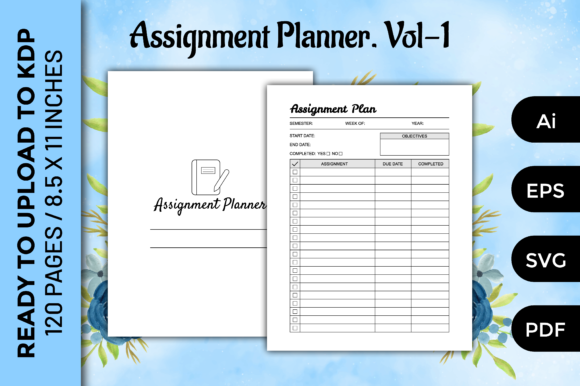
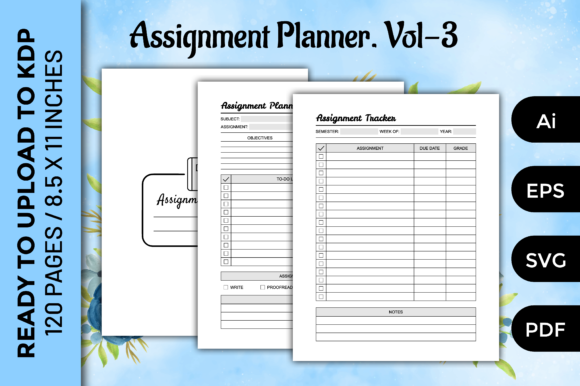
When evaluating resources for KDP, the distinction between a "done-for-you" product and an "editable template" is crucial. While pre-made interiors save time, they often lead to duplicate content issues when hundreds of sellers use the exact same file. The Assignment Tracker for KDP included in this volume bridges that gap by providing high-quality source files. By offering AI, EPS 10, and SVG formats alongside the print-ready PDF, this resource empowers publishers to create unique variations while maintaining professional standards.
Technical Specifications That Ensure Print Quality
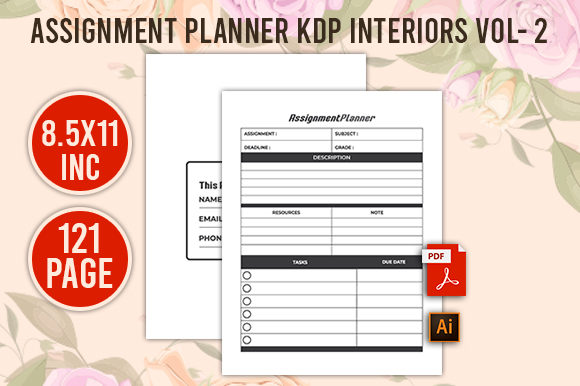
One of the most common pitfalls in self-publishing is neglecting technical print requirements. A beautiful design can quickly become unsellable if margins are off or resolution is poor. This template is engineered specifically to mitigate those risks. The 8.5×11 inch size is the industry standard for academic planners, offering ample writing space without being cumbersome for students carrying heavy backpacks.
Resolution is non-negotiable in print publishing. This interior is rendered at 300 DPI, ensuring that every line, checkbox, and header prints with crisp clarity. Blurry text or pixelated graphics are immediate indicators of low-quality production that result in negative reviews. Furthermore, the no-bleed configuration simplifies the upload process. Bleed errors are among the top reasons for KDP rejection or delayed approval. By utilizing a safe no-bleed layout, publishers can streamline their workflow and reduce the back-and-forth with Amazon’s automated review system.
- Dimensions: Standard 8.5×11 inches for optimal usability
- Resolution: 300 DPI for professional-grade printing
- Bleed Settings: No-bleed format for error-free uploads
- Page Count: 120 pages, balancing thickness with cost-efficiency
The Strategic Advantage of Editable Source Files
The true value of the Assignment Planner - KDP Interiors Vol-3 lies in its editability. Having access to Adobe Illustrator (AI) and EPS 10 files transforms this purchase from a single product into a potential product line. Publishers can modify fonts to match specific branding, adjust color schemes to target different demographics, or add proprietary logos to build a recognizable series.
Consider the practical application of SVG files in this context. Scalable Vector Graphics allow for infinite resizing without quality loss, but more importantly, they enable modular design changes. A publisher might take the base assignment tracker layout and adapt it for different niches: one version for nursing students with clinical rotation tracking, another for music students with practice logs, and a third for graduate researchers managing thesis milestones. This level of adaptation is impossible with flattened PDFs but becomes effortless with vector-based source files.
This flexibility also addresses the seasonality of the academic market. When back-to-school season ends, demand for general assignment planners drops. However, with editable files, you can quickly pivot. Changing headers from "Semester Schedule" to "Professional Development Tracker" allows the same core interior to serve adult learners and corporate trainees year-round. The ability to iterate rapidly based on market trends is what separates hobbyists from serious publishing businesses.
Designing for User Utility and Retention
An assignment planner must solve actual problems for students to be commercially viable. The 120-page count in this template is not arbitrary; it reflects a thoughtful balance between functionality and manufacturing cost. Too few pages make the planner feel insubstantial, while too many drive up printing costs and eat into royalties. This length supports a full semester of daily tracking plus additional reference sections.
Modern students operate in hybrid environments, juggling digital submissions with physical note-taking. Effective assignment trackers acknowledge this reality. When customizing this template, consider how the layout facilitates quick data entry. Students need to capture due dates, course codes, and priority levels in seconds between classes. Clean typography and intuitive spacing are essential. The provided templates offer a solid foundation, but the editable nature allows you to refine these elements based on customer feedback or competitor analysis.
Visual hierarchy plays a significant role in user satisfaction. Important fields like "Due Date" or "Exam" should command attention through weight or positioning rather than clutter. Using the Illustrator files, you can experiment with subtle shading or iconography to guide the eye without increasing ink coverage excessively. Remember that KDP standard color printing carries higher costs than black and white; smart design achieves visual appeal through layout and contrast rather than expensive color usage.
Integrating Templates Into Modern Publishing Workflows
Efficiency determines profitability in volume publishing. The Assignment Planner - KDP Interiors Vol-3 is structured to integrate seamlessly into professional workflows. The inclusion of multiple file formats means compatibility across different software ecosystems. While Adobe Illustrator is the industry standard, EPS 10 files open reliably in Affinity Designer, CorelDRAW, and even some free alternatives like Inkscape. This accessibility ensures that technical barriers don’t prevent creative iteration.
For publishers managing multiple SKUs, organization is paramount. Maintaining master files separate from export-ready PDFs prevents accidental overwrites. A recommended workflow involves keeping the original AI files in a dedicated project folder, creating modified versions for each niche variation, and exporting final PDFs only when ready for upload. This systematic approach reduces errors and makes future updates manageable.
Cross-platform consistency matters when building a brand. If you sell digital versions of your planners on Etsy or Gumroad alongside KDP print editions, the SVG and PDF files serve dual purposes. The same high-quality interior can be marketed as a printable download for iPad users or as a physical book for traditional students. This multi-channel approach maximizes the return on investment for each template purchased.
Evaluating Quality Before Publication
Before listing any customized version of this assignment tracker, thorough validation is essential. Always order a proof copy to verify that margins align correctly and that the binding doesn’t obscure functional areas. What looks perfect on screen may feel cramped in print. Test the writing experience personally; ensure checkboxes are appropriately sized and lines are spaced for comfortable handwriting.
Market research should inform customization decisions. Analyze reviews of competing assignment planners to identify pain points. Do customers complain about insufficient space for project descriptions? Is there demand for grade calculation sections? Use these insights to guide modifications to the base template. The editable files exist precisely for this purpose—to allow responsive product development based on real user needs rather than assumptions.
Finally, consider the metadata implications of your design choices. Unique interiors support stronger keyword strategies because they genuinely differ from competitors. When your planner includes specialized features enabled by thoughtful customization, your product description and backend keywords can reflect authentic differentiation. This alignment between product reality and marketing messaging improves conversion rates and builds long-term brand credibility in the educational planning niche.